Guide · Executors
Executor Checklist Canada: What Records to Keep When Settling an Estate
What to gather, who to call, which tax returns are due and when, and how to keep estate accounts that hold up when the CRA or a beneficiary asks questions.
Not legal or tax advice. This guide summarizes what the CRA and Service Canada publish, to help you keep organized records. Estate law is provincial and every estate is different. For decisions about a specific estate, talk to an estate lawyer (a notary in Quebec) and a tax professional.
Settling an estate rarely starts with a plan. It starts with a drawer of bank statements, a phone that keeps ringing and a will you may not have read in years. You don't need to be an accountant to do this well, but you do need to write things down from the first week.
A quick word on terms. The estate is everything the person owned and owed when they died. The CRA calls the person settling it the legal representative, which is usually the executor named in the will. In Quebec the role is called the liquidator. If there's no will, a court appoints an administrator instead.
What documents does an executor need to gather?
Start one folder, paper or digital, and collect these before you call anyone.
- Proof of death. A death certificate, or the statement of death from the funeral director. Ask for several copies.
- Proof that you're in charge. The will with any codicils (later amendments), plus the grant of probate or letters of administration if there are any.
- Tax basics. The person's social insurance number (SIN), their last notice of assessment and any returns they hadn't filed yet.
- What they owned. Bank and investment statements near the date of death, property deeds, and RRSP, RRIF and TFSA statements showing any named beneficiaries.
- What they owed. Credit cards, loans, the mortgage and any balance owing to the CRA.
- Benefits being paid. CPP, OAS or a workplace pension.
For each asset, write down two numbers: what it was worth on the date of death, and what the person originally paid for it. The tax section below explains why, and these figures are much easier to find now than in two years.
Who do you notify at the CRA and Service Canada?
The CRA. Report the date of death (opens in a new tab) as soon as you can, even if the person wasn't getting benefits, so that no payments have to be paid back later. You can call 1-800-959-8281 (choose any option; there's no menu item for a death) or mail Form RC4111 (opens in a new tab) to the person's tax centre. Have their SIN, date of birth, address and a recent notice of assessment in front of you.
Reporting the death is not the same as telling the CRA you're the executor. That's a separate step (opens in a new tab): you send a copy of the death certificate and the document naming you, such as the will or the grant of probate, with the person's SIN on each document. The CRA says this generally takes 28 business days to process. For online access to past returns and slips, register for Represent a Client first and add your RepID to the documents.
Service Canada. If the person received CPP or OAS, call 1-800-277-9914 to cancel the benefits (opens in a new tab). The estate keeps the payments for the month of death. Anything deposited after that month has to be returned. If the death happened in a province, the provincial vital statistics office tells the SIN program automatically, according to Service Canada (opens in a new tab), so that's one call you can skip.
The CPP death benefit. If the person contributed enough to CPP, the estate can get a one-time death benefit (opens in a new tab). For deaths on or after January 1, 2025, it's a basic $2,500 plus a top-up of another $2,500 if the person never received a CPP or QPP retirement pension or disability benefit and doesn't leave a spouse or partner eligible for a survivor's pension. Service Canada says the executor should apply within 60 days of the death. Payment takes about 6 to 12 weeks.
If the person lived in Quebec, Revenu Québec and Retraite Québec have their own steps as well.
What tax returns does an executor have to file?
Every person who dies needs a final T1 return (opens in a new tab). It reports income from January 1 to the date of death, using the tax package for the year of death.
It also holds a surprise for many families. For tax purposes, the CRA treats the person as having sold everything they owned just before death (opens in a new tab) at fair market value. This is called a deemed disposition. If the cottage, the stock portfolio or a rental property went up in value, the gain is reported on the final return even though nothing was sold. Property left to a surviving spouse or common-law partner can often pass without tax until they sell it, if certain conditions are met. That's why you need both numbers for each asset.
You may also need:
- Optional returns, such as a return for "rights or things" (income earned but not yet paid at death, like a final paycheque). They're optional, but one can reduce the tax owing.
- Returns for past years the person never filed.
- A T3 return for the estate. If the estate earns income after the death, such as interest or dividends, or realizes a gain before everything is handed out, it generally files its own T3 return. Most estates qualify as a graduated rate estate for up to 36 months, which means they're taxed at the same graduated rates as a person.
If the person owned a rental, its income and expenses up to the date of death go on the final return. Our T776 rental expenses guide walks through the expense lines.
When are the deadlines for a deceased person's taxes?
These are the CRA's filing and payment due dates (opens in a new tab) for someone who died:
| Return | Due date |
|---|---|
| Final T1 return | Death between January 1 and October 31: April 30 of the next year. Death between November 1 and December 31: six months after the date of death. |
| Final T1, if the person or their spouse ran a business | June 15 of the next year, or six months after death if it happened between December 16 and 31. Any balance owing is still due on the regular payment date. |
| Return for rights or things (optional) | The later of one year after death or 90 days after the notice of assessment for the final return. |
| Earlier years they never filed | If the person died before filing last year's return and before its due date, six months after death. Older unfiled years keep their original due dates. |
| Estate's T3 return | 90 days after the estate's tax year-end. For most estates, you pick that first year-end, any date up to one year after the death. |
So if your mother died on March 14, her final return is due April 30 of the next year. If she died on November 20, it's due May 20. A late return with a balance owing costs 5% of the balance plus 1% per full month late, up to 12 months, so file on time even if you can't pay in full yet.
What is a clearance certificate, and when do you apply for one?
A clearance certificate (opens in a new tab) is the CRA's written confirmation that the estate has paid all the income tax, GST/HST, interest and penalties it owes. It protects you. If you distribute the estate without one and tax turns out to be owing, you can be held liable for it, up to the value of what you handed out.
You ask for it with Form TX19, Asking for a Clearance Certificate (opens in a new tab), but timing matters. Apply only after the returns are filed, you've received the notices of assessment and the balance is paid. Don't send the TX19 with the returns; the CRA says that slows down their assessment. Along with the will and probate documents, it asks for:
- a detailed list of the assets at the date of death, including jointly held property and registered plans, with their adjusted cost base (roughly, what was paid for them) and their fair market value when distributed
- a statement of what's been distributed so far
- a plan for distributing whatever is left, including any holdback
- names, addresses and SINs of beneficiaries receiving property other than cash
A holdback is money you keep in the estate account until the certificate arrives, in case the CRA finds tax owing. The CRA says it acknowledges a request within 45 days and the assessment can take up to 120 days. Tell beneficiaries about this wait early, so it doesn't come as a surprise.
How should an executor track estate expenses and distributions?
Look again at that TX19 list. The CRA wants an asset list and a statement of distributions, and beneficiaries will want much the same. Keep a simple ledger from day one and you'll have both ready.
It's far easier if all estate money goes through one bank account opened in the estate's name. Then record every transaction:
- Money in: bank balances moved in, final pension payments, the CPP death benefit, proceeds from selling the car.
- Money out: the funeral, debts, taxes, legal and accounting fees, upkeep on the empty house.
- Distributions: the date, the beneficiary, what they received (cash or an item), its value, and a signed receipt from them.
Say you paid the funeral home $6,000 on your own credit card in the first week. Record it, keep the invoice, and reimburse yourself from the estate account with a note linking the two. A year later, nobody will remember who paid what.
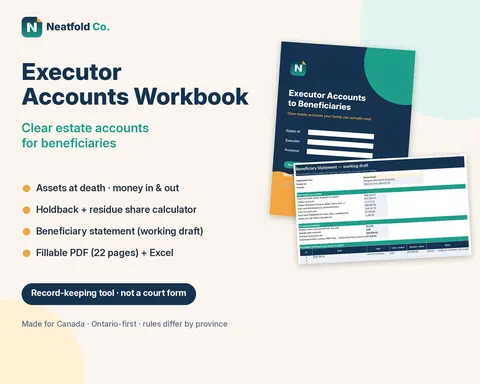
A spreadsheet with columns for date, description, category, money in, money out and a receipt reference is enough. If you'd rather not build one, the Neatfold Co. Executor Accounts Workbook (opens in a new tab) on Etsy is set up this way, with an asset list at the date of death, a holdback and residue share calculator and a beneficiary statement. It's a record-keeping tool, not a court form. You can see our other estate templates on the OPLARI home page.
Do you need probate?
Sometimes. Probate is a court process that confirms the will is valid and that you have authority to act. Banks and other institutions holding the person's assets may require it before they'll release them. Whether you need it, what it costs and how to apply depend on the province or territory where the person lived. Canada.ca's estates and wills page (opens in a new tab) links to each province's rules,; British Columbia's wills and estates page (opens in a new tab) is one example. If you're not sure, ask an estate lawyer before you move any money.
How long should an executor keep estate records?
The CRA's general rule is six years from the end of the last tax year the records relate to (opens in a new tab). For estates there's a specific exception: once you have a clearance certificate for the property under your control, the CRA says you can destroy the records. If anyone files an objection or appeal, keep everything until it's resolved.
That's only the CRA's side. Provincial rules about an executor's accounts are separate, so check with the estate lawyer before you shred anything. Scanning the whole file and keeping a backup costs very little.
Executor checklist: records to keep
- Copies of the death certificate (or funeral director's statement of death), the will and any codicils, and the probate grant or letters of administration
- The deceased's SIN, last notice of assessment and any unfiled returns
- A list of everything owned at the date of death, with its value on that date and what it originally cost
- Registered plans (RRSP, RRIF, TFSA) and life insurance, with any named beneficiaries noted
- Debts and bills at the date of death, and when and how each was paid
- Dates you notified the CRA and Service Canada, and the name or reference number of anyone you spoke to
- A ledger of every dollar in and out of the estate, with a receipt or statement for each
- Every distribution to a beneficiary: date, what they got, its value and a signed receipt
- Copies of every return filed, every notice of assessment and the clearance certificate
Frequently asked questions
How long does an executor have to settle an estate in Canada?
There's no single federal deadline for finishing. The CRA's deadlines apply to the tax returns: the final return is generally due April 30 of the year after death, or six months after the death if it happened in November or December. Everything else, including probate and how long administration may reasonably take, is governed by the law of the province or territory where the person lived.
Do I need a clearance certificate before distributing the estate?
The CRA says you need one if you're distributing the estate's assets. If you hand out property without one and tax turns out to be owing, you can be personally liable for the unpaid amount, up to the value of what you distributed. You ask for it with Form TX19 after the returns are filed and assessed and the tax is paid.
How long does a CRA clearance certificate take?
The CRA says it sends an acknowledgement letter within 45 days of getting your request, and the assessment can take up to 120 days if all the documents were provided. It may take longer if the CRA decides to audit first.
Who can apply for the CPP death benefit?
If there's an estate, the executor named in the will, or the administrator appointed by the court, applies, and Service Canada says the executor should apply within 60 days of the death. If no one applies for the estate, it can be paid to whoever paid for the funeral, then the surviving spouse or common-law partner, then the next of kin. For deaths on or after January 1, 2025, it's a basic $2,500 plus a possible $2,500 top-up.
What happens to CPP and OAS payments after someone dies?
The estate is entitled to the payments for the month of death. Anything paid after that month has to be returned, either by having the bank send back the direct deposit or by returning the cheque. Call Service Canada at 1-800-277-9914 to stop the benefits.
Does every estate have to file a T3 return?
No. The CRA says a T3 return is generally needed if the estate realizes a gain or receives payments after the death, such as investment income. If the only income after death can be reported by a beneficiary, a T3 may not be needed. The CPP death benefit, for example, can go on the beneficiary's own return.
How do I get the deceased person's tax records?
Send the CRA a copy of the death certificate (or a funeral director's statement of death) and the document naming you executor, such as the will or grant of probate, with the person's SIN on each document. Processing generally takes 28 business days. Register for Represent a Client first if you want online access to past returns and slips.
Sources
Rules, amounts and deadlines come from these Government of Canada pages, as they read in October 2026. Check them again before you act, because they change.
- Canada Revenue Agency, Doing taxes for someone who died (opens in a new tab)
- Canada Revenue Agency, Notify the CRA of a date of death (opens in a new tab)
- Canada Revenue Agency, Represent someone who died (opens in a new tab)
- Canada Revenue Agency, What returns you need to file (opens in a new tab)
- Canada Revenue Agency, Filing and payment due dates for someone who died (opens in a new tab)
- Canada Revenue Agency, Taxable capital gains on property, investments and belongings (opens in a new tab)
- Canada Revenue Agency, Apply for a clearance certificate (opens in a new tab)
- Canada Revenue Agency, Form TX19, Asking for a Clearance Certificate (opens in a new tab)
- Canada Revenue Agency, Where to keep your records and for how long (opens in a new tab)
- Service Canada, Cancel CPP and OAS benefits after a death (opens in a new tab)
- Service Canada, CPP death benefit (opens in a new tab)
- Government of Canada, What to do when someone dies: Notify of a death (opens in a new tab)
- Government of Canada, Estates and wills (opens in a new tab)
- Government of British Columbia, Deal with wills and estates (opens in a new tab)
This guide is general information, not legal, tax or accounting advice, and it isn't a substitute for the official publications above. Neatfold Co. is not affiliated with the Canada Revenue Agency or Service Canada. Rules vary by province and territory, so get professional advice for a specific estate.