Guide · Landlords
How to Track Rental Expenses for Your T776: A Simple Guide for Canadian Landlords
A line-by-line walk through Form T776, plus a monthly habit that saves you from a shoebox of receipts in April. Everything here is checked against the CRA's own rental guide.
Not tax advice. This guide explains the CRA's published rules in plain language to help you keep good records. It doesn't cover every situation. For decisions about your own return, talk to a CPA or a qualified tax professional.
If you rent out a basement suite or a condo, the CRA wants to see the numbers on Form T776, Statement of Real Estate Rentals (opens in a new tab). The form itself isn't the hard part. Finding last March's furnace invoice is. So this guide spends most of its time on what to track during the year.
What is Form T776?
The T776 is where you show what the rental brought in, what it cost you, and the difference, which is your net rental income or loss. The CRA's Guide T4036, Rental Income (opens in a new tab) explains each line.
One question comes first: is this rental income from property, or a business? If you rent the space and supply only basic services such as heat, light, parking and laundry, the CRA generally treats it as income from property, and the T776 is the right form. Start adding cleaning, security or meals and you may be running a business, which is reported on a different form.
Rental properties always run on the calendar year, January 1 to December 31.
The CRA expects most landlords to use the accrual method, where December's rent counts in December even if the tenant pays it on January 3, and a repair counts when you incur it rather than when you pay the bill. The simpler cash method is allowed only if you have almost nothing owing either way at year-end and your result would come out nearly the same.
What counts as rental income?
Rental income is what you earn from renting property you own or have use of: houses, apartments, rooms, office space and other property. On the T776 it lands in a few places:
- Line 8141, gross rents for all units. The total rent you earned in the year, paid to you in cash or by cheque. Short-term rentals are also totalled separately on line 8140.
- Line 8230, other income. For example, amounts you receive for granting, extending or cancelling a lease. If a tenant pays part of the rent in services, you report what those services are worth here. The CRA's own example is a tenant who plows the parking lot after every snowfall in exchange for lower rent.
- Line 8299, total gross rental income. Line 8141 plus line 8230. It goes on line 12599 of your return, and your net result goes on line 12600.
What rental expenses can you deduct?
The CRA's rule is short: you can deduct any reasonable expenses you incur to earn rental income (opens in a new tab). Part 4 of the T776 groups them into these lines. If every receipt gets its line number the day you file it away, year-end becomes adding up columns.
| Line | Category | Typical examples |
|---|---|---|
| 8521 | Advertising | Listing ads for a vacant unit, finder's fees |
| 8690 | Insurance | The current year's premiums for the rental property (spread multi-year policies over the years they cover) |
| 8710 | Interest and bank charges | Interest on money borrowed to buy or improve the rental. Not mortgage principal |
| 8810 | Office expenses | Small items like stationery and stamps. Desks and filing cabinets are capital items |
| 8860 | Professional fees | Legal fees to prepare leases or collect overdue rent, bookkeeping and tax-prep help |
| 8871 | Management and administration fees | Property manager fees, agents who collect rent or find tenants |
| 8960 | Repairs and maintenance | Labour and materials for minor repairs. Not the value of your own labour |
| 9060 | Salaries, wages and benefits | Pay for a superintendent or maintenance staff, plus employer contributions |
| 9180 | Property taxes | Property taxes for the period the property was available for rent |
| 9200 | Travel | Getting to the property to collect rent, supervise repairs or manage it, under the same conditions as vehicle costs |
| 9220 | Utilities | Gas, oil, electricity, water and cable, if your lease says you pay them |
| 9281 | Motor vehicle expenses | Reasonable vehicle costs, if you meet the CRA's conditions (see the FAQ) |
| 9270 | Other expenses | Condo fees, landscaping, lease cancellation payments, rental phone costs |
If you live in part of the property, you can claim only the share of whole-building costs that relates to the rented area, using square metres or number of rooms. The CRA's example: rent 4 rooms of a 10-room house and you can deduct 100% of costs for the rented rooms plus 40% of costs like property taxes and insurance. The T776 has a "personal portion" column for this.
What can't landlords deduct?
A few costs feel like rental expenses but are on the CRA's list of rental expenses you can't deduct (opens in a new tab):
- Repayments of mortgage principal (only the interest counts)
- Land transfer taxes when you bought the property (they're added to its cost instead)
- The value of your own time and labour
- Penalties on a notice of assessment or reassessment
- The non-compliant share of costs for a short-term rental that doesn't meet provincial or municipal registration, licence or permit rules
Is it a current or a capital expense?
Most of the judgment calls in rental bookkeeping happen here. Current expenses recur and give a short-term benefit, like repairs that keep the property in the condition it was in when you got it. You deduct them in the year you incur them. Capital expenses give a lasting benefit, such as buying or improving the property. You generally can't deduct them all at once. Instead you claim them over several years as capital cost allowance.
The CRA's guide gives these examples:
| Usually current | Usually capital |
|---|---|
| Painting the outside of a wooden house | Putting vinyl siding on it |
| Repairing wooden steps | Replacing wooden steps with concrete ones |
| Rewiring that doesn't improve the building beyond its original condition | Buying a refrigerator, a separate asset |
| Ordinary maintenance on a property you already rent out | Repairing a used property you just bought to make it rentable |
So the plumber who clears the kitchen drain goes on line 8960, while the new fridge for the suite goes on your capital list. When you honestly can't tell, put it on the capital list with a question mark and let your tax professional make the call at year-end.
How does CCA work on a rental property?
Capital cost allowance is how you get a deduction, a slice at a time, for things that wear out over years.
Each type of property belongs to a class with its own rate. Most buildings bought after 1987 are Class 1 at 4%. Furniture and appliances are generally Class 8 at 20%. The rate applies to whatever balance is left each year, so the claim gets smaller over time.
Land doesn't wear out, so it gets no CCA. That's why you split the purchase price between land and building and claim only on the building.
Three rules catch new landlords. In the year you buy something, the half-year rule usually lets you base the claim on only half its cost (some newer property gets accelerated treatment instead). CCA is optional, and you can't use it to create or increase a rental loss. And selling has consequences. If the sale price pushes a class's remaining balance below zero, that amount is added back to your income (a recapture). If you've sold everything in a class and a balance is still left, you can usually deduct it (a terminal loss).
CCA is worked out in Area A of the T776 and has many special cases. Your job during the year is simply to keep a clean list of capital purchases with dates, costs and receipts.
How long should landlords keep records?
The CRA wants invoices, receipts, contracts and other documents behind every number. You don't send them in with your return. You keep them, because if the CRA asks and you can't produce a receipt, it may not allow the expense.
Generally, you must keep your records for at least six years (opens in a new tab) from the end of the tax year they relate to. That includes cancelled cheques, bank statements, a copy of your return and your notices of assessment. If you keep records digitally, the CRA's electronic record-keeping circular (opens in a new tab) says they have to stay readable for the whole period, and it recommends keeping a backup copy in Canada. A phone photo of a receipt in a folder you back up counts as a start. See IC78-10R5 (opens in a new tab) for the full retention rules.
How to track rental expenses each month
Pick a day early in the month, the same one every month, and work through this:
- Log the rent. For each unit, record the amount, date received and method. Note anything late or unpaid.
- Gather receipts. Empty your wallet, your email and the glovebox. Hardware store slips are the ones that go missing.
- Code each expense. Write the T776 line next to it, such as 8960 for a plumber or 9180 for property tax.
- Separate the capital items. Anything that's a new asset or an improvement goes on your capital list instead.
- Split shared costs. If you live in the building, apply your rented-area percentage to whole-building bills like insurance and property tax.
- Check against your bank statement. A missing rent deposit or a charge with no receipt is much easier to sort out this month than next spring.
- File and back up. Scan or photograph receipts, then back up the folder.
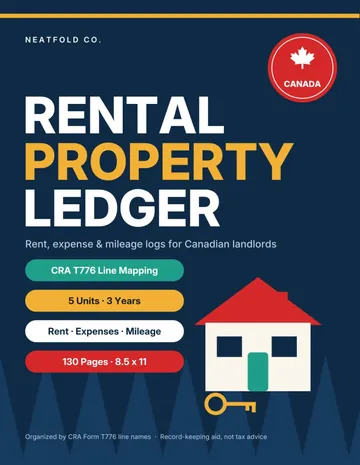
In January you total each line, total the rent, and give your capital list to whoever works out your CCA. If you prefer paper, the Neatfold Co. Canadian Rental Property Ledger (opens in a new tab) on Amazon.ca has monthly rent logs and expense logs already sorted by T776 line names. If you'd rather use a spreadsheet, the Canadian Landlord Rental Tracker (opens in a new tab) on Etsy covers the same ground in Excel or Google Sheets and builds the year-end summary for you. You can see both, along with our other landlord templates, on the OPLARI home page.
Year-end checklist for your T776
- Rent received each month, by unit, with the date and how it was paid
- Every receipt and invoice saved and labelled with its T776 line
- Capital purchases (appliances, furniture, major improvements) on a separate list
- Personal-use share worked out if you live in part of the property
- Mileage log, if you claim vehicle costs
- Bank and credit card statements matched to your log each month
- Lease, insurance policy, property tax bill and mortgage statement filed together
- A backup copy of digital records, kept for at least six years
Frequently asked questions
Is mortgage interest deductible on a rental property in Canada?
The interest is, the principal isn't. Interest on money you borrowed to buy or improve the rental goes on line 8710. The part of each payment that pays down the loan is not deductible. If you refinance and use the money for something personal, the interest on that extra amount isn't deductible either.
Can I write off a new fridge or stove for my rental?
Not all in one year. The CRA treats an appliance as a separate asset, so buying one is a capital expense. Appliances and furniture generally go in CCA Class 8 and are claimed over several years. Fixing the existing fridge is a repair, and that goes on line 8960.
Where do I report rental income on my tax return?
Fill in Form T776 first. Your total gross rental income from line 8299 goes on line 12599 of your return, and your net rental income or loss from line 9946 goes on line 12600. You don't send receipts with the return, but keep them in case the CRA asks.
Can I claim expenses if I rent out part of my home?
Yes, for the rented part. Costs that relate only to the rented space, like repairs inside the suite, count in full. Costs for the whole house, like property tax and insurance, are split by floor area or number of rooms. The personal share goes in the personal portion column and is totalled on line 9949.
How long do I need to keep rental receipts for the CRA?
Generally six years from the end of the tax year they relate to. Keep receipts, bank statements, a copy of your return and your notices of assessment. If you keep records electronically, they must stay readable for that whole period.
Can I deduct mileage for driving to my rental property?
It depends. With one rental property in the general area where you live, you can deduct reasonable vehicle costs only when you do repairs yourself and need to bring tools and materials; driving to collect rent is personal. With two or more rental properties at different sites, you can also deduct trips to collect rent, supervise repairs and manage the properties.
Do I have to claim capital cost allowance every year?
No. You can claim anything from zero up to the maximum for the year. The CRA points out that if you don't owe tax for the year, you may not want to claim it, because every claim reduces what's left for future years.
Sources
Rules and line numbers are from the 2025 versions of these CRA publications, current as of October 2026. Check them each year, since they change.
- Canada Revenue Agency, Guide T4036, Rental Income (T4036(E) Rev. 25) (opens in a new tab)
- Canada Revenue Agency, Form T776, Statement of Real Estate Rentals (opens in a new tab)
- Canada Revenue Agency, Rental expenses you can deduct (opens in a new tab)
- Canada Revenue Agency, Rental expenses you cannot deduct (opens in a new tab)
- Canada Revenue Agency, How long should you keep your income tax records? (opens in a new tab)
- Canada Revenue Agency, IC78-10R5, Books and Records Retention/Destruction (opens in a new tab)
- Canada Revenue Agency, IC05-1, Electronic Record Keeping (opens in a new tab)
This guide is general information, not tax, accounting or legal advice, and it isn't a substitute for the CRA's own publications. Neatfold Co. is not affiliated with the Canada Revenue Agency. A CPA or qualified tax professional is strongly advised for your own return.